


You spent months building your brand. The ads are finally working. Orders are coming in. And then a customer reaches out to support with a problem. Your team responds. The customer comes back with the same problem two days later. They don't leave a bad review. They just never buy again.
That's what poor first call resolution actually costs you. Not just an extra support ticket. A customer who quietly walks away and never tells you why.
For Shopify founders and customer experience heads, this is one of the most expensive problems hiding in plain sight. You're losing money on repeat contacts. You're burning out your support agents. And you're losing customers who had a problem that could have been fixed the first time.
First call resolution (FCR) is the metric that tells you how often your support team resolves a customer issue in a single interaction, with no callbacks, no transfers, no follow-up needed. This article breaks down what FCR means, how to calculate it, and seven practical ways to improve it for your Shopify brand.
What Is First Call Resolution?
First call resolution is when a customer's issue gets fully resolved the first time they contact your support team. No callbacks. No transfers. No "I'll check with my manager and follow up."
The metric applies across every support channel: phone, live chat, email, social DMs. The channel doesn't matter. What matters is whether the customer had to reach out again about the same problem.
FCR is often used interchangeably with first contact resolution. Same concept, broader name. Whichever term you use, the principle is identical: resolve it once and move on.
Beyond the number itself, what is FCR really telling you? It reflects how well your tools, processes, agents, and policies work together. When FCR is low, it's rarely just a training problem. It usually means something upstream is broken: a confusing return policy, agents without access to the right data, or support tickets landing on the wrong person.
Brands like Gymshark, Allbirds, and FIGS handle enormous support volumes. For them, and for any Shopify brand operating at scale, first call resolution is a direct window into how healthy the entire support operation actually is.
Why First Call Resolution Rates Matter for Shopify Brands
The financial case for improving first call resolution rates is hard to ignore.
According to SQM Group, a 1% improvement in first call resolution delivers three things simultaneously:
- +1% customer satisfaction (CSAT)
- -1% operating costs
- +1.4 NPS points
For an average contact center, that 1% improvement translates to roughly $300,000 in annual savings. For fast-growing Shopify brands where support costs scale directly with order volume, that compounds fast.
Every time a customer has to call back, their satisfaction drops by an average of 15%. Two callbacks in, and you've wiped out nearly a third of their goodwill. Gartner research found that 94% of customers who experience low-effort support are likely to buy again. High first call resolution rates build that low-effort experience.
The retention math is also blunt. Repeat customers make up just 21% of a typical Shopify store's customer base but generate 44% of revenue. Losing them over a support failure that a better process could have prevented is one of the most expensive mistakes in ecommerce.
The First Call Resolution Formula
Calculating your first call resolution rate is straightforward.
FCR Rate = (Issues Resolved on First Contact / Total Issues) x 100
Here's an example: your team handles 1,000 support contacts in a month. 720 get resolved without any follow-up. Your first call resolution formula gives you a 72% FCR rate.
Simple in theory. The complication is in how you measure "resolved." Agent-reported FCR and customer-confirmed FCR often tell very different stories. An agent marks a ticket closed. The customer emails again two days later about the same issue. That's a failed first call resolution, but it won't appear in your numbers unless you're tracking it correctly.
The most reliable method is a post-interaction survey. A single "Was your issue fully resolved today? Yes/No" question at the end of every contact gives you first call resolution rates based on actual customer experience, not agent judgment. It's the most honest data you'll get.
What Are Good First Call Resolution Rates? Industry Benchmarks
Industry benchmarks from SQM Group put the average FCR rate across all industries at 70%. Retail and ecommerce average 78%, the highest of any industry sector.
Anything above 80% is considered world-class, and only about 5% of contact centers ever get there.
Here's how first call resolution rates break down by call type for ecommerce brands:
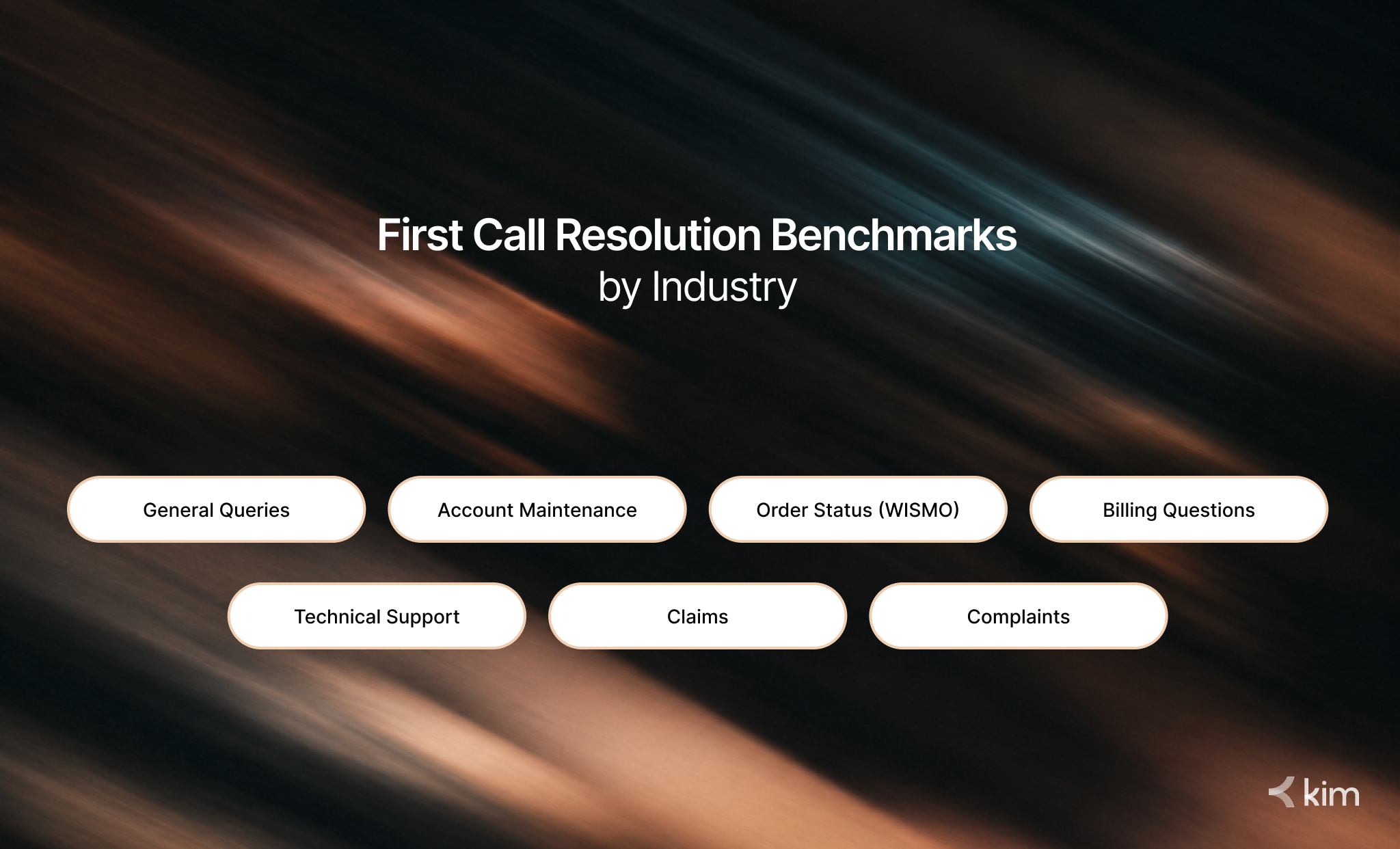
Source: SQM Group, Freshworks call center industry data
For Shopify brands selling apparel, beauty, or consumables, complaints and return calls can pull your overall FCR down fast. A fashion brand with a confusing returns process might sit in the low 50s on that call type. Since returns are high-volume, that drags the total number down significantly.
If your overall FCR is below 65%, the issue almost certainly isn't your agents. It's your processes, your tools, or both.
Why Most Shopify Brands Fail at First Call Resolution
Here's what the research actually says about why first call resolution fails.
SQM Group's breakdown of root causes:
- 49% organizational failures: bad processes, missing tools, unclear policies, agents without decision authority
- 38% agent-level failures: insufficient training, communication gaps, asking the wrong questions
- 13% customer factors: incomplete information, unrealistic expectations
Half of your first call resolution failures are a business problem, not a people problem. That's actually good news. It means fixing your processes has more leverage than retraining your team.
The most common organizational failures for Shopify brands:
- Agents toggling between Shopify, a shipping dashboard, and a helpdesk while a customer waits on the line
- Return policies that require manager sign-off so every escalation is a guaranteed callback
- No internal knowledge base, which means agents guess or put customers on hold to ask a colleague
- Manual routing sending every contact into a general queue so the wrong person picks up and transfers
- Nobody measuring first call resolution at all so nobody knows what to fix
Most growing Shopify brands are guilty of at least two of these. The seven strategies below address each one directly.
7 First Call Resolution Best Practices for Shopify Brands
1. Give Agents a Single View of Every Order
This is the highest-impact, fastest fix. When your agents have to toggle between Shopify, a shipping tool, and a helpdesk just to look up one order, your first call resolution suffers on every single contact.
Integrate your helpdesk directly with Shopify so agents see the order, shipping status, payment details, and customer history on one screen. Tools like Gorgias, Zendesk, or kim.cc pull this data together so agents can answer questions without asking customers to repeat themselves. Kim.cc is a free AI helpdesk built specifically for Shopify brands that gives your team everything in one place. When the information is right there, resolution time drops and first call resolution rates go up immediately.
2. Simplify Your Return and Exchange Policy
Returns are consistently one of the lowest-FCR call types for Shopify brands. The main reason is policy complexity.
If your agents need manager approval to process a standard return, you are guaranteeing a callback. Give agents a simple decision tree with three options: full refund, exchange, or store credit. Give them clear authority to execute any of them. Document the criteria and remove the escalation path for standard cases.
Brands like Allbirds keep return policies explicit and accessible because they know ambiguity costs money. The fewer steps between "customer calls" and "refund issued," the higher your first call resolution rate on that call type.
3. Build a Searchable Internal Knowledge Base
Your agents waste an enormous amount of time hunting for information: product specs, regional shipping cutoffs, warranty terms, troubleshooting steps. Without a centralized, searchable knowledge base, they guess or put customers on hold.
A solid knowledge base covers:
- Shipping policies by region and carrier
- Common product questions with decision trees
- Return and exchange procedures
- FAQ answers for your top 10 issue types
- Escalation paths for edge cases
Organizations using knowledge-centered support see FCR improve by up to 15% from better information access alone. It's one of the highest-ROI investments you can make in your support stack.
4. Route Contacts to the Right Agent
Sending every contact into a general queue is one of the most avoidable first call resolution killers. When a billing question lands on someone who only handles product inquiries, a transfer is almost certain. Every transfer means no first-contact resolution.
Skills-based routing matches contacts with the agents best equipped to handle them. Even a basic IVR menu ("press 1 for order status, press 2 for returns") beats a single general queue. AI-powered routing can identify customer intent before the contact reaches a human, cutting misrouted calls by more than half in documented implementations.
Gymshark does this well with their FAQ-first flow, routing customers toward self-service for order tracking and reserving agents for higher-complexity issues like complaints or sizing disputes.
5. Automate Order Status Before It Becomes a Support Ticket
WISMO ("where is my order?") calls are the single highest-volume contact type for most Shopify brands. They're also the easiest to prevent.
Proactive shipping notifications via SMS and email reduce inbound volume before it starts. For contacts that still come in, automated responses pulling real-time tracking data can resolve WISMO without a human agent touching it. That's a direct first call resolution rate improvement and a cost reduction at the same time.
FIGS, the Shopify-based healthcare apparel brand, handles high ticket volumes across a broad customer base. Brands at that scale can't afford to have agents manually responding to "where is my order?" dozens of times a day. Automation handles the predictable volume so agents can focus on what actually needs a human.
6. Track First Call Resolution Rates by Call Type, Not Just Overall
You can't improve first call resolution if you're not measuring it. And measuring one overall number hides the problems that actually need fixing.
Your returns FCR might be 52% while your general inquiries FCR sits at 74%. Those need completely different fixes. A monthly review of FCR by call type, paired with pattern analysis of repeat contacts, tells you exactly where to focus. Trace callbacks to root causes: process gaps, training gaps, or product issues.
The measurement method matters too. Customer-confirmed FCR from post-interaction surveys is always more accurate than agent-reported FCR. Agents mark tickets closed in good faith, but customers don't always agree.
7. Train Your Agents on the Actual Calls They Handle
Generic customer service training improves soft skills. It doesn't move first call resolution numbers. Targeted training on the specific call types your team handles most is what actually moves the needle.
For most Shopify brands, the top five call types are WISMO, returns and exchanges, product questions, billing issues, and complaints. Role-play each one. Give agents clear decision trees. Give them the authority to resolve issues without escalating. Update the training materials monthly based on what your support data reveals about real conversations.
SQM Group's research attributes 38% of FCR failures to agent-level gaps. Targeted training on your real top call types, not generic theory, is how you close that gap. These are first call resolution best practices in action: specific, data-driven, and tied to what's actually breaking.
FAQ: First Call Resolution
1) What is first call resolution (FCR)?
First call resolution is when a customer's issue gets fully resolved on the first contact with your support team, with no callbacks, transfers, or follow-ups required. It applies to phone, chat, email, and any other support channel.
2) What is the first call resolution formula?
FCR Rate = (Issues resolved on first contact / Total issues) x 100. For the most accurate data, use post-interaction surveys with customers rather than relying on agent-reported resolution status.
3) What is a good FCR rate for Shopify brands?
A good first call resolution rate for ecommerce is 70 to 79%, according to SQM Group. The retail sector averages 78%, the highest of any industry. Anything above 80% is world-class, but only about 5% of contact centers ever reach it.
4) Why are my first call resolution rates low?
According to SQM Group, 49% of FCR failures are organizational: bad processes, missing tools, or agents without decision authority. Only 38% come from agent performance. Start by auditing your processes before retraining your team.
5) How do agents affect first call resolution?
Agents account for 38% of FCR failures through insufficient training, poor communication, or not asking the right questions. The fix is targeted training on your actual top call types, not generic customer service theory.
6) Does AI improve first call resolution for Shopify brands?
Yes. AI support tools excel at the most common Shopify call types: order status, returns, product questions. They resolve them consistently on first contact. One documented deployment showed a 32% FCR improvement after AI handled refund and delivery queries.
Conclusion: First Call Resolution Is Your Support System's Report Card
Here's the truth. A customer who had to call twice is already halfway out the door. They won't tell you they're leaving. They'll just stop buying. And you'll never know why.
First call resolution is the clearest signal of whether your support operation is actually working. A low FCR rate means customers are calling back, costs are rising, and loyalty is quietly disappearing.
The good news? Most FCR problems are fixable, and half of them are process problems, not people problems. Give your agents the right tools, the right data, and the right authority. Simplify your returns flow. Build a knowledge base. Route contacts intelligently. And start measuring first call resolution rates by call type, not just as one blunt overall number.
Top Shopify brands don't leave first call resolution to chance. They build systems that make resolving issues on the first contact the default, not the exception.
If you want to see what that looks like in practice and how AI-powered support helps Shopify brands hit consistent, measurable first-contact resolution at any volume.


