



Refund emails are one of the most common things your support team deals with. And they're also one of the most mishandled.
A customer bought something, but it didn't work out so now they want their money back. How you respond to this in the next few minutes can either save that relationship or end it.
The right refund emails keep customers calm, build trust, and protect your brand. The wrong ones push people straight to a chargeback or a scathing review.
In this blog, you'll get 10 ready-to-copy templates for every scenario you'll face in 2026 - plus a breakdown of how to handle refund requests the right way and what to include in a no refund policy. Think of it as your library of refund email samples, ready to use whenever you need them.
What Is a Refund Email?
A refund email is any message exchanged between a customer and a business about returning money for a purchase.
There are two sides to refund emails:
- Customer-initiated refund requests - The customer writes in asking for their money back.
- Business-initiated responses - You write back to confirm, deny, partially approve, or explain the refund.
Both need to be clear, empathetic, and fast. A customer who gets a quick, human response is far more likely to stay loyal - even after a frustrating experience.
According to Zendesk's Customer Experience Trends Report, 73% of customers will switch to a competitor after just one bad support interaction. Refund handling is often that make-or-break moment.
That's why having a set of ready templates isn't optional. It's a core part of your customer experience strategy.
How to Handle Refund Requests the Right Way
Most refund requests aren't really about the money. They're about trust.
When a customer asks for a refund, they're asking: Do you actually care about me? How you answer that question matters more than the $30 in question.
Here's how to handle each situation without losing the customer - or your sanity:
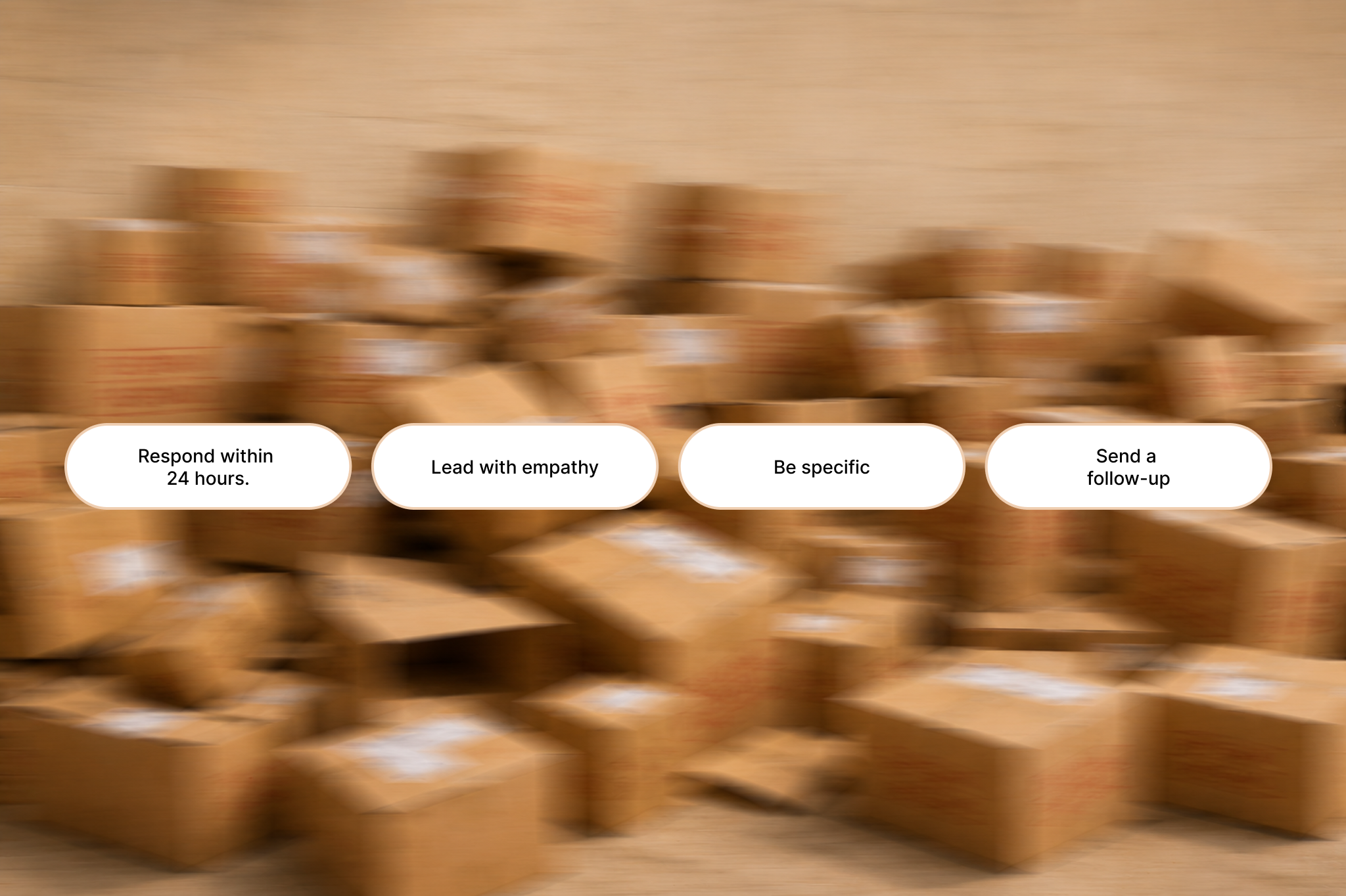
1) Respond within 24 hours. The longer they wait, the angrier they get. Speed signals you take the issue seriously.
2) Lead with empathy, not policy. Don't open with "per our return policy…" - open with "I'm really sorry this happened." Policy comes second.
3) Be specific about what happens next. Vague timelines like "soon" create more tickets. Say "5–7 business days" instead.
4) Don't make customers fight for reasonable refunds. If the request is fair, approve it fast. One quick refund is worth more than the lifetime value you'd lose by dragging it out.
5) Send a follow-up after the refund is processed. A short confirmation email shows you're paying attention.
Common Types of Refund Requests You'll See
These are the customer returns that land in support queues every single day:
- Product arrived damaged or broken
- Wrong item shipped
- Order never arrived
- Customer changed their mind (within the return window)
- Duplicate charge on their account
- Subscription cancellation with unused time remaining
- Product didn't match the description
Each scenario calls for a slightly different tone and approach. That's exactly why pre-written templates save so much time - they give your team a consistent, pre-approved starting point for every situation.
10 Refund Email Templates for 2026
These templates are organized by scenario. Copy, paste, and customize with your order details and brand voice. Use them as refund email samples - adjust the tone to match your brand.
Template 1: Refund Request Received (Acknowledgement)
Use this as an instant auto-reply when a customer request comes in and you need time to review it.
Subject: We've received your refund request - Order #[XXXX]
Hi [First Name],
Thanks for reaching out. We've received your refund request for order #[XXXX] and our team is reviewing it now.
You'll hear back from us within 24–48 hours with a resolution.
If you have any photos, screenshots, or additional details to share, feel free to reply to this email - it helps us move faster.
We're sorry for the inconvenience and appreciate your patience.
Warm regards,
[Your Name]
[Brand Name]
Support Team
Template 2: Full Refund Approved
Use this when you're approving a full refund with no friction.
Subject: Your refund has been approved - Order #[XXXX]
Hi [First Name],
Good news - we've approved your refund of $[Amount] for order #[XXXX].
The funds will be returned to your original payment method within 5–7 business days, depending on your bank.
We're really sorry things didn't work out this time. If there's anything we could do better, we'd genuinely love to hear it.
[Your Name]
[Brand Name]
Support Team
Template 3: Partial Refund Approved
Use this when only part of the order qualifies.
Subject: Partial refund processed - Order #[XXXX]
Hi [First Name],
We've reviewed your refund request and processed a partial refund of $[Amount] for order #[XXXX].
This covers [e.g., the damaged item]. The remaining amount isn't eligible under our refund policy because [brief, clear reason - e.g., the other items were delivered as described].
If you have any questions about this, we're happy to walk you through it.
[Your Name]
[Brand Name]
Support Team
Template 4: Refund Denied (Policy-Based)
This is the trickiest one. Lead with empathy before policy.
Subject: Update on your refund request - Order #[XXXX]
Hi [First Name],
Thank you for reaching out about order #[XXXX]. We've carefully reviewed your request.
Unfortunately, this order doesn't qualify for a refund under our current return policy because [reason - e.g., it falls outside our 30-day return window].
We know that's not what you were hoping to hear, and we're sorry for that. As a goodwill gesture, we'd like to offer you [store credit / a discount on your next order].
Please reply if you'd like to take us up on that - we'd love the chance to make it right.
[Your Name]
[Brand Name]
Support Team
Template 5: Damaged Product Refund
Move fast on these. Don't ask the customer to jump through hoops.
Subject: We're sorry - refund issued for your damaged order
Hi [First Name],
We're really sorry your order arrived damaged. That's not the experience we want for you at all.
We've processed a full refund of $[Amount] to your [payment method]. It should appear within 5–7 business days.
You don't need to return the item. Please just dispose of it safely.
Thank you for letting us know - this kind of feedback genuinely helps us improve.
[Your Name]
[Brand Name]
Support Team
Template 6: Wrong Item Received
Own the mistake immediately.
Subject: Wrong item sent - here's how we're fixing it
Hi [First Name],
We're so sorry - we sent you the wrong item. That's completely on us.
We've issued a full refund of $[Amount] to your original payment method. If you'd prefer, we can also ship the correct item right away - just let us know which you'd like.
Again, we apologize for the mix-up. We're working on making sure this doesn't happen again.
[Your Name]
[Brand Name]
Support Team
Template 7: Order Never Arrived
Confirm the investigation before issuing the refund.
Subject: Refund issued - missing order #[XXXX]
Hi [First Name],
We've looked into your order and confirmed it hasn't arrived as expected. We're sorry about that.
We've issued a full refund of $[Amount] to your [payment method]. It should appear within 5–7 business days.
If the package shows up after this point, you're welcome to keep it - no need to return anything.
[Your Name]
[Brand Name]
Support Team
Template 8: Subscription Cancellation Refund
Keep this one warm - they're leaving, but they might come back.
Subject: Your subscription has been cancelled - refund details inside
Hi [First Name],
We've cancelled your subscription as requested. A refund of $[Amount] for the unused portion of your billing period has been processed and will appear within 5–7 business days.
We're sorry to see you go. If something didn't work for you or there's anything we could improve, we'd genuinely love to know.
You're always welcome back.
[Your Name]
[Brand Name]
Support Team
Template 9: Store Credit Offer Instead of Refund
A good option when cash refunds aren't possible but you still want to retain the customer.
Subject: We'd like to make it right - store credit offer
Hi [First Name],
We're sorry your experience didn't go as expected. While a cash refund isn't available in this case, we'd like to offer you $[Amount] in store credit as an apology.
There's no expiry date on it, and you can use it on anything in our store.
We value your business and want to earn it back. Let us know if you'd like us to apply the credit to your account.
[Your Name]
[Brand Name]
Support Team
Template 10: Follow-Up After Refund Processed
Don't skip this one. A follow-up shows customers you actually care about the outcome.
Subject: Just checking in - refund for order #[XXXX]
Hi [First Name],
We wanted to follow up to make sure your refund of $[Amount] came through. It was processed on [Date] to your [payment method].
If it hasn't appeared yet, please give it one more business day. Banks can sometimes take a little longer. If you're still not seeing it after that, reply here and we'll investigate immediately.
We hope we can serve you better next time.
[Your Name]
[Brand Name]
Support Team
How to Write a No Refund Policy (Without Killing Your Conversion Rate)
Not every business offers refunds - and that's a legitimate choice, as long as you're upfront about it.
A strict no-returns stance doesn't have to feel harsh. Here's how to write one that protects your business while still feeling fair.
1) What Your Returns Policy Should Cover
A strong returns policy should cover:
- Which products or services are eligible (and which aren't)
- The time window customers have to make a request
- The condition items must be in to qualify
- How customers should initiate the process
- What happens if the item is defective or the error was on your end
2) Sample No-Returns Language
"All sales are final. We do not offer refunds or exchanges on completed orders unless the item you received was damaged, defective, or incorrect. If this applies to your order, please contact us within 7 days of delivery with your order number and photos of the issue."
This is firm but fair. It sets expectations clearly while leaving a door open for genuine mistakes.
3) Where to Post Your Returns Policy
Put it everywhere customers look before they buy:
- Product pages (near the "Add to Cart" button)
- The checkout page
- Order confirmation emails
- Your website footer
Customers shouldn't have to hunt for your return terms. If they can't find them, you'll get angry messages from people claiming they "didn't know." A consistent, well-communicated return policy also cuts the volume of refund emails your team handles each week.
Platforms like Gorgias, Freshdesk, and kim.cc can automate policy-based responses while keeping a human in the loop for edge cases - so your team isn't rewriting the same reply over and over.
Tips for Writing Refund Emails That Actually Land
Even the best templates need a human touch. These refund email samples are starting points - here are tips to personalize each one so they feel genuine and not auto-generated.
- Use the customer's name. It immediately makes the message feel less robotic.
- Acknowledge before you explain. The first sentence should validate their frustration - not defend your process.
- Be specific about timelines. "5–7 business days" is far better than "soon." Vague timelines generate follow-up tickets.
- Drop the legal language. "Per our terms and conditions…" reads as hostile. Keep it plain and human.
- End with an offer to help. A simple "let us know if you need anything else" gives them a clear next step.
FAQ
What should a refund email include? Every refund email should include the customer's name, order number, refund amount, payment method, and an expected timeline. Keep it concise - customers want answers, not paragraphs.
How long should a refund email be? Short. Three to five sentences is enough for a confirmation. For denied claims, a bit more context is helpful - but never write a wall of text.
Can I use these refund email templates for Shopify? Yes. These refund email samples work for any eCommerce platform - Shopify, WooCommerce, BigCommerce, or otherwise. Just swap in your order details and brand voice.
What's the difference between a refund request and a refund confirmation? A refund request is the customer asking for money back. A refund confirmation is your response after the refund has been processed.
What if I have a no-refund policy? You can legally operate a no-refunds stance in most regions - but you must communicate it clearly before customers complete a purchase. Always check local consumer protection laws, as they vary significantly.
How do I write a refund email that keeps the customer? Be fast, be empathetic, and don't make them feel like they're asking for a favour. Acknowledge the issue first, explain what happens next, and always follow up after the refund lands.
Conclusion
Refund emails don't have to be stressful. With the right refund email templates ready to go, your team can respond to refund requests quickly, consistently, and with genuine care - every single time.
The 10 refund email samples in this guide cover every situation you'll encounter: damaged products, missing orders, subscription cancellations, denied claims, and more. Copy them, make them yours, and start sending better refund emails today.
The brands that handle refund requests well don't just avoid chargebacks. They turn frustrated customers into loyal ones.
How many customers have received a refund from your brand but never made another purchase?
Every refund email shapes how customers remember the experience. If your responses are slow, inconsistent, or impersonal, you could be losing customers long after the refund is processed.


