Offshore Customer Service for Shopify: A Simple Guide for Shopify Brands

Running a Shopify store is exciting, but customer questions can grow faster than expected. At first it’s a few emails a day. Then it’s dozens. Soon your team is answering the same questions again and again:
“Where is my order?”
“Can I return this?”
“I typed the wrong shipping address.”
For many small and Medium brands, customer support slowly turns into a full-time job. That’s when people start looking into offshore customer service. It simply means your support team is based in another country, helping customers through email, chat, and social messages.
In this blog, we’ll cover the benefits, the common misconceptions, and what you should know before you hire. We've also included a quick onshore vs offshore comparison and explain where customer service automation and call center outsourcing fit in.
What is offshore customer service?
Offshore customer service simply means customer support is handled by a team in another country. They can reply to customers by email, live chat, social DMs, and sometimes phone.
Offshore support is not “set it and forget it.” You still own the customer experience. Your job is to give the team:
- clear policies (refunds, replacements, exceptions),
- training materials,
- a simple escalation policy (who handles tricky cases),
- and a knowledge base they can use when they are unsure.
When those basics are in place, offshore support can feel like an extension of your brand.
Benefits of offshore customer service
1) 24/7 support Availability:-
Online stores never really close. Customers buy late at night and on weekends. With offshore customer service, you can offer wider support coverage without burning out your in-house team. Faster replies often reduce frustration and improve CSAT (customer satisfaction).
2) Access to Global talent
Offshore hiring opens up a much bigger talent pool. Many brands hire in places like the Philippines because written English is strong and customer service is a common career path. Platforms like kim.cc help by screening for communication skills, empathy, and role fit, so you’re not guessing.
3) Lower costs
Support costs add up, especially if you want evenings and weekends covered. Offshore teams can often deliver strong support at a lower operating cost. That gives Shopify SMBs room to invest in marketing, inventory, or better fulfillment, while keeping customer support consistent.
4) Scalability and flexibility
Ticket volume doesn’t stay flat. A sale, holiday season (4th of July, Christmas), or a viral product can create a sudden ticket backlog. Offshore teams are often easier to scale up (or adjust coverage hours) than hiring locally every time you grow. That flexibility matters when growth comes in waves.
5) Enhanced customer satisfaction
Customers mainly care about speed, clarity, and respect. Offshore support can raise satisfaction when it shortens first response time (FRT) and gives customers clear next steps. In many cases, customers never even think about where the agent is, because the help is simply good.
Common misconceptions about offshore customer service
1) “Quality will be worse”
Quality depends more on training, a solid knowledge base, and clear rules than on location. If agents know your policies and have good examples, they can handle Shopify tickets well. If policies are unclear, quality drops anywhere, onshore or offshore.
2) “Communication will be difficult”
This is the biggest fear, and it’s fair. Your support replies are your brand voice. But strong communication comes from good screening and onboarding, not from being local.
Many offshore teams hire in places like the Philippines because English is strong, and the customer tone tends to be warm and clear. That’s also why some SMBs use platforms like kim.cc, to screen for written English, empathy, and brand fit before the agent ever touches a customer ticket.
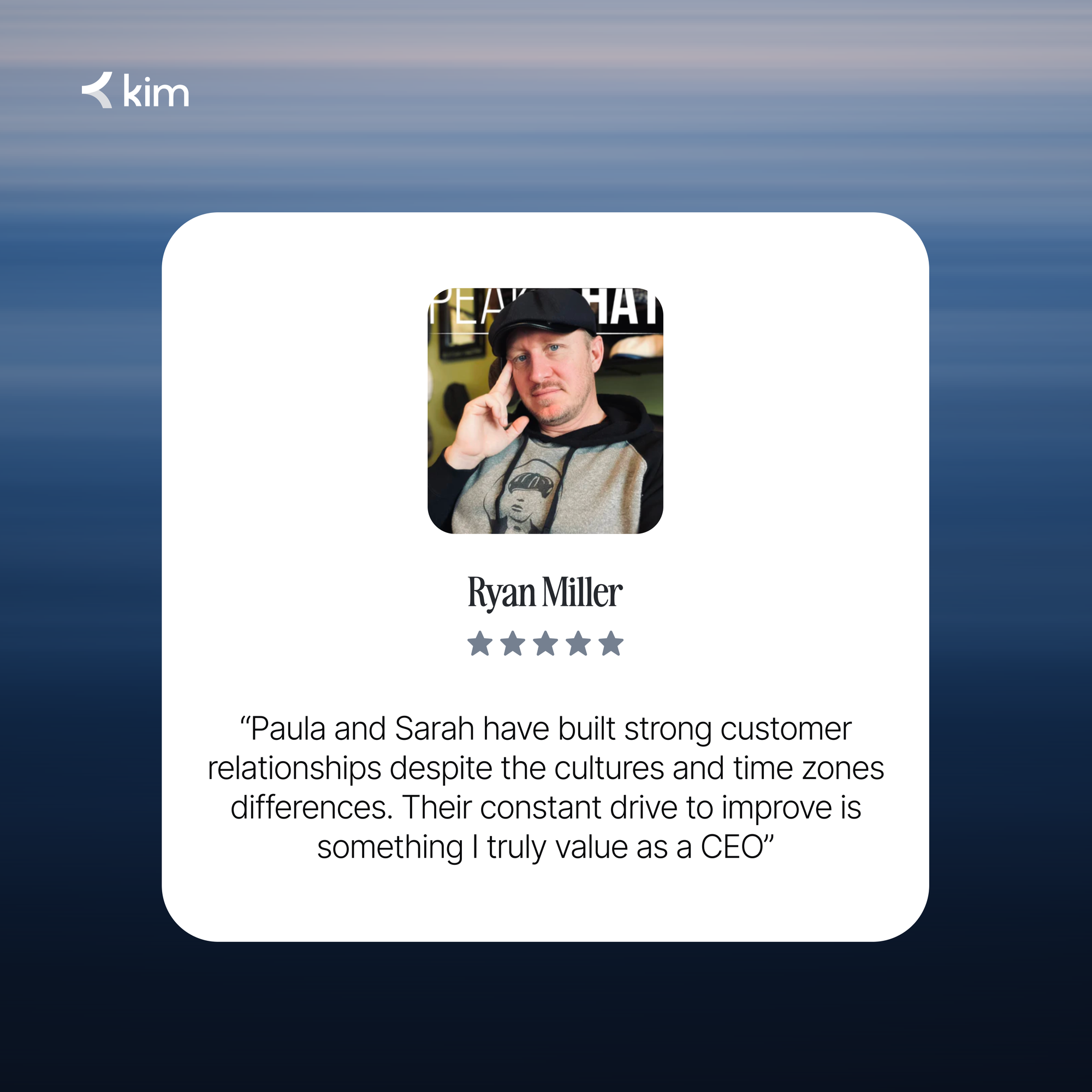
Ryan Miller, founder of Peaky Hats, had concerns about culture and time zone differences. But after working with kim.cc's superagents, he shared that they built real customer relationships and improved over time, proving that communication can be excellent when hiring is done right.
3) “I’ll lose control”
You don’t lose control if you set the rules. Offshore teams should follow your escalation policy, your tone guide, and your approval rules. The control comes from your SOPs, not from geography.
4) “Security is risky”
Security matters. But it’s manageable with simple steps: limited permissions, role-based access, and clear rules about what agents can and can’t do. For example, you can require approvals for large refunds or sensitive account changes.
5) “Customers will react negatively”
Most customers don’t care where support is based. They care about response time, politeness, and whether their problem gets solved. If the experience is fast and helpful, the location rarely matters.
Onshore vs offshore: a quick comparison
A lot of founders ask: onshore vs offshore, which is better?
Here’s a simple comparison.
| Factor | Onshore support | Offshore support |
|---|---|---|
| Cost | Higher | Usually lower |
| Hiring speed | Slower | Often faster |
| Coverage | Harder for nights/weekends | Easier with time zones |
| Brand voice | Easier at first | Easy with training |
| Scaling | Can be slow | Often easier |
A simple rule that works for many Shopify SMBs:
Keep complex, sensitive issues close to home.
Offshore the repeatable tickets first.
What you should know before hiring (this is the important part)
If you do one thing after reading this blog, do this section.
Step 1: Decide what you will outsource first
If you’re thinking about Shopify customer service outsourcing, start with the repeatable work.
Great to outsource first:
- order status and shipping updates (WISMO: “Where is my order?”)
- return and exchange questions (if rules are clear)
- address changes and cancellations (with rules)
- basic product FAQs
Better to keep in-house at first:
- chargebacks and fraud
- VIP customers
- messy exceptions that don’t follow your policy
This is how you protect your customer experience while you test offshore support. It also keeps your team from getting stuck in a growing ticket backlog.
Step 2: Choose a region that matches your needs
Here’s a high-level guide. There’s no “best.” There is only “best for your store.”
| Region | Good fit for | Strengths | Watch-outs |
|---|---|---|---|
| Philippines | Shopify email/chat support | Strong written English, friendly tone | Needs clear rules for exceptions |
| Latin America | Live chat coverage | US time-zone overlap | English varies more |
| India | Large support volume | Process-driven teams, scale | Tone may need more coaching |
| Eastern Europe | Technical support | Strong technical skills | Often higher cost |
A practical tip: If live chat and real-time teamwork matter most, time zone overlap becomes important. If written support quality matters most, focus on writing tests and brand-tone training.
Step 3: Don’t skip automation (but keep it simple)
You don’t need fancy systems to start. A little customer service automation can remove a lot of tickets.
Simple automation ideas:
- clear tracking page to reduce “Where is my order?”
- returns portal if your policy is straightforward
- auto-tagging and routing (shipping vs returns vs product questions)
- saved replies/macros that match your tone
Automation should feel like help, not a wall.
One easy win is building a simple FAQ and knowledge base (even a living Google Doc at first). It reduces repeat tickets and makes training faster.
Step 4: Decide which hiring model fits you
Here’s a clean comparison.
| Model | Best for | Pros | Cons |
|---|---|---|---|
| Platforms like Kim (offshore) | SMBs who want vetted talent fast | Screening + faster hiring + easier scaling | You still need policies and training |
| Onshore hiring | Premium CX, complex support | Tight brand alignment early on | Higher cost, slower scaling |
| Freelancers | Very small volume | Flexible, low commitment | Quality and availability can vary |
No matter which model you choose, ask about reporting. You don’t need complicated dashboards, but you should be able to see basic signals like response time (FRT), customer satisfaction (CSAT), and whether tickets are being solved or bounced around.
Step 5: Do you need phone support?
Many Shopify brands don’t really require phone support. Email and chat cover most needs.
But if you do want phone support, call center outsourcing can make sense when:
- your product is expensive,
- your customers need urgent help,
- or your category is high-touch.
If you add phones, start small: limited hours + clear scripts + clear escalation rules.
Also, one more practical note: phone support has its own “speed” metric (often called AHT, or average handle time). You don’t need to obsess over it, but you should make sure calls aren’t rushed in a way that hurts customer trust.
FAQs
Is offshore customer service good for Shopify stores?
Yes, especially for repeatable tickets like order status, shipping questions, and returns/refunds. Start small, keep policies clear, and use a pilot period before scaling.
What should I outsource first for Shopify customer service outsourcing?
Start with WISMO (order status), shipping updates, returns/exchanges (if your policy is clear), and basic product questions. Keep fraud, chargebacks, and VIP issues in-house until the offshore team is fully trained.
How do I make sure offshore agents match my brand voice?
Give them a short tone guide, examples of “good replies,” and a simple knowledge base. Do weekly review chats early on, and use saved replies/macros to keep wording consistent.
Will customer service automation replace my support team?
No. Good automation reduces repetitive tickets so agents can focus on real problems. Use automation for tracking, returns steps, tagging/routing, and suggested replies, then keep humans for edge cases and emotional situations.
Onshore vs offshore: what’s better for customer experience?
Onshore can feel easier at first because the team is close, but offshore can deliver great customer experience when training and policies are clear. Many Shopify SMBs do best with a hybrid approach: offshore handles repeatable tickets, and onshore handles escalations.
When does call center outsourcing make sense for ecommerce?
It’s most useful when customers need urgent answers, your product is high value, or your business is high-touch. Many Shopify stores start with email and chat first, then add phone later if it truly helps.
Final thoughts
Offshore customer service can work beautifully for Shopify stores. The benefits are real: extended coverage, access to global talent, lower costs, flexibility during spikes, and better customer satisfaction.
But success comes from doing it in a simple, safe way:
- start with repeatable tickets,
- set clear refund and escalation rules,
- build a basic knowledge base,
- use light customer service automation,
- and scale step-by-step.
And if communication is your worry, don’t assume offshore means a barrier. Better screening and better onboarding can make offshore support feel like it’s coming from your own team.